Emperor Zeno’s bad roll, reconstructed from a poem
A poem records a Byzantine emperor rolling 2, 5 and 6 and ending up with eight exposed checkers. Reconstructing the position shows how the roll forced him to break all three of his pairs.
CUBE BackgammonPublished Updated
In a poem by Agathias, the Byzantine emperor Zeno throws three dice and gets a two, a five and a six. After playing them, he has eight checkers standing alone on the board, where they are vulnerable to being hit. The poet records the position in enough detail for later historians to reconstruct how the roll caused so much damage.
Zeno ruled the Eastern Roman Empire in the fifth century, and the game in the poem was an older relative of backgammon, played with fifteen checkers each and three dice. To follow his turn, we have drawn the conventional reconstruction on our Las Vegas board, with Zeno playing Ivory and his opponent’s black pieces shown in red. The points are numbered so that Ivory moves toward 1.
Why each die breaks a pair
Before the roll, Zeno has seven checkers piled on point 19, pairs on 5, 6 and 15, and single checkers on 2 and 16. A pair protects its two checkers from being hit, so only those last two are exposed.
In this reconstruction, each die must be played separately and all three must be used if possible. A point held by two or more opposing checkers is blocked, and Zeno cannot bear off while he still has checkers outside his home board.
Follow Zeno’s 2–5–6
The stack of seven on 19 looks like an obvious place to find a move, but all three destinations are closed: the 2 would land on 17, the 5 on 14 and the 6 on 13, each occupied by a red pair. The lone checker on 16 is stuck for the same reason, with red pairs on 14, 11 and 10. His other lone checker, on 2, cannot move forward without leaving the board, and bearing off is not yet allowed.
To use the roll, Zeno has to move a checker from 5 to 3 with the 2, from 6 to 1 with the 5, and from 15 to 9 with the 6. Each move leaves a single checker behind and puts another on an empty point, creating six exposed checkers in addition to the two already standing alone. All six orders of the three dice lead to the same eight single checkers and the untouched stack of seven.
What we can recover from the poem
Agathias describes the arrangement and the outcome without supplying a complete rulebook, so this diagram reconstructs one turn while leaving questions about the rest of the game open. Ulrich Schädler’s Locus Ludi version identifies rules added to make a playable game, including how captured pieces re-enter. We do not need to settle those questions to follow the three moves shown here.
Why anyone wrote this down
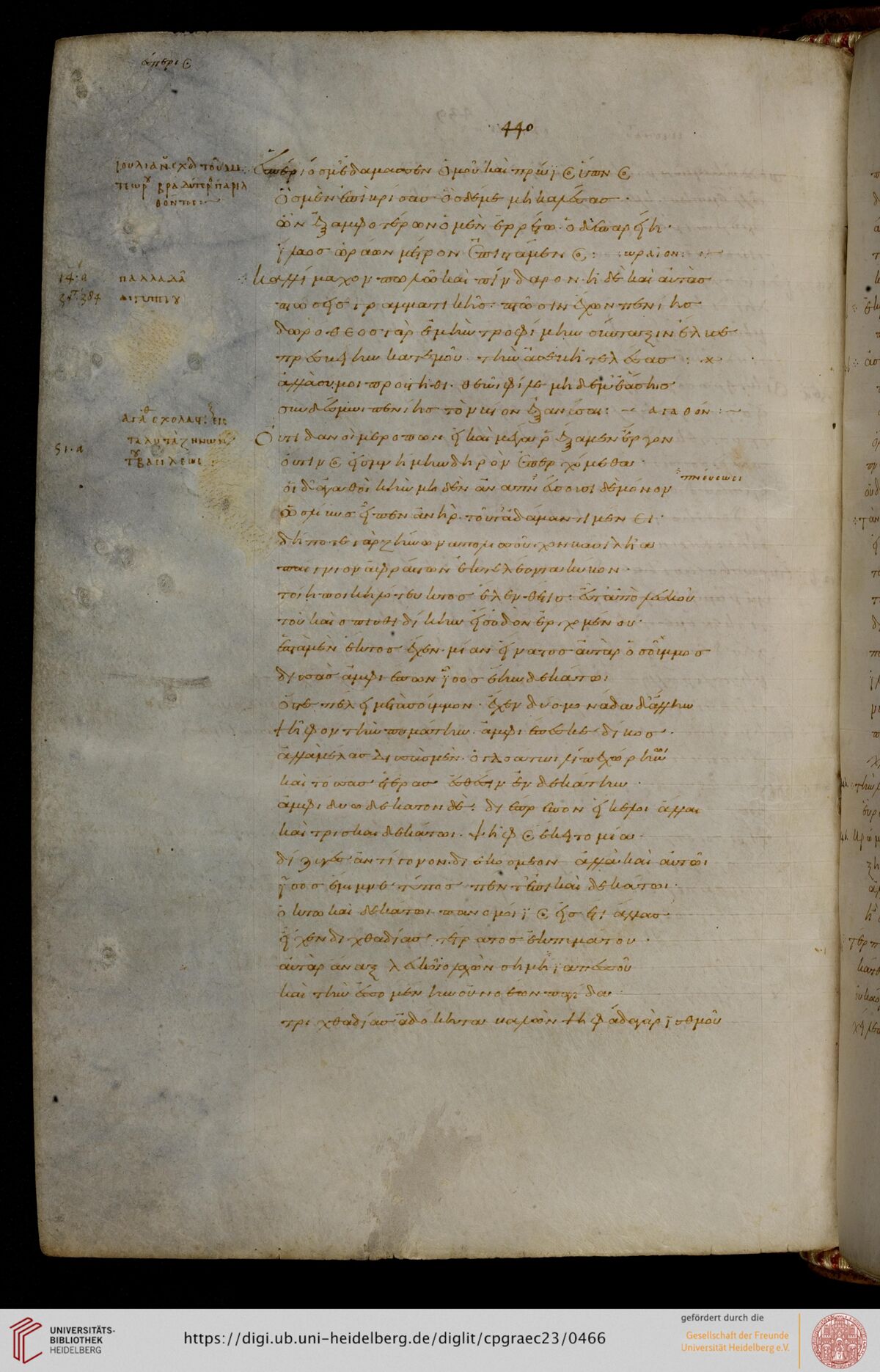
The story survives in epigram 9.482 of the Greek Anthology, which opens with a complaint about fame. Agathias says that ordinary people can accomplish great things and still be forgotten, while even the smallest actions of the powerful are preserved. He chooses an emperor’s unfortunate turn at a board game as his example, then carefully lists the positions of both players’ pieces.
Agathias’s poem begins in the lower part of this page of the tenth-century Palatine Anthology (Cod. Pal. graec. 23, p. 440) and continues on page 441.Digitisation: Heidelberg University Library. Source · Public Domain Mark 1.0.View the complete image ↗
Agathias ends by advising everyone to avoid the game, since even the emperor could not escape its unpredictable fortune. His account has left us able to set up the pieces, throw the same three numbers and watch Zeno’s pairs come apart more than fifteen centuries later.
The principal source is Agathias, Greek Anthology 9.482, with the Greek text and W. R. Paton’s English translation. Our board follows R. G. Austin’s 1934 diagram as reproduced in Peter Schamber, XII Scripta (2009), printed pp. 21–22; the source’s point p becomes 25 − p in our numbering. The three moves and all six dice orders have been checked for this position under the stated movement rules. The wider limits of reconstruction are discussed in Ulrich Schädler’s “Zeno’s Tavli”, ERC Locus Ludi. The poem does not report the final score or say who won the game.