A backgammon set in the Mary Rose carpenter’s cabin
When archaeologists excavated the Mary Rose, an English warship from Henry VIII’s navy that sank in 1545, they found a backgammon set among the tools in its carpenter’s cabin.
CUBE BackgammonPublished Updated
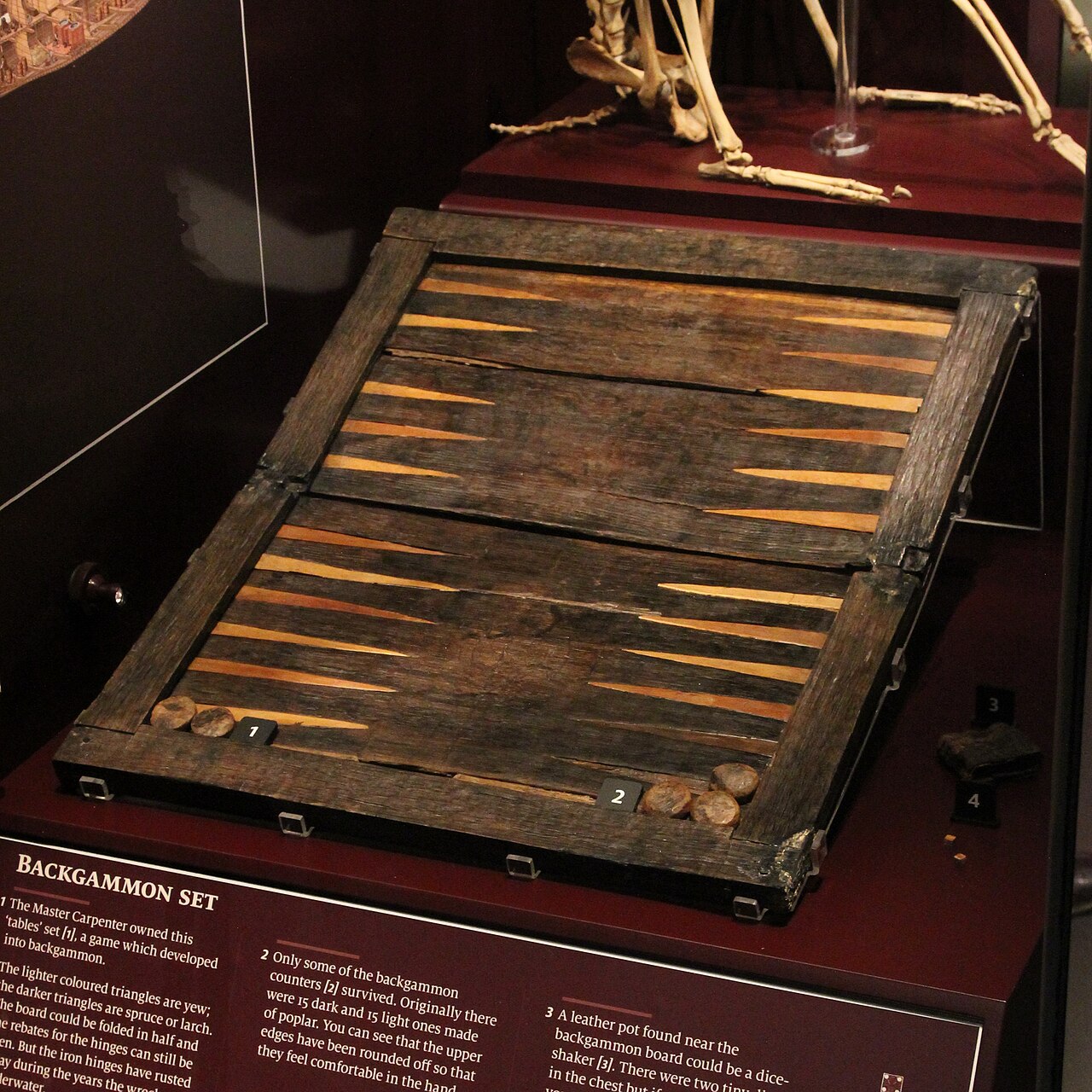
The Mary Rose was a wooden warship in Henry VIII’s navy that sank off England’s south coast in 1545. Among the tools and unfinished woodwork recovered from its carpenter’s cabin, archaeologists found a backgammon set, which curator Alex Hildred mentions alongside the workbench, baskets and offcuts in the museum’s account of the excavation.
The ship sank on 19 July 1545 in the Solent, the stretch of sea between Portsmouth and the Isle of Wight, during a battle with the French fleet. The crew’s daily tasks can still be traced through the things they left aboard, with playing pieces belonging to that history alongside the tools of their trades.
A workshop with a few home improvements
The carpenter’s tables board on display at the Mary Rose Museum, photographed in 2026.Photograph: Tim Sheerman-Chase / Wikimedia Commons. Source · CC BY 4.0.Reduced size, uncropped.View the complete image ↗
The museum’s description of the cabin makes it an unusually personal space. It had a sliding door, two benches and a window cut through the ship’s side that could be closed in bad weather. Its occupant had also extended the cabin.
Three chests held different parts of life aboard. One contained tools; another, probably used for clothes, preserved traces of fabric. A more elaborate walnut chest had a lock, dovetail joints and a small internal shelf, with pewter plates, coins, rings and a leather book cover among its contents.
The backgammon set fits into this collection of belongings. It gives the workshop another possible use, with a board that could bring another person into the space when work allowed. The excavation account does not tell us who that opponent was, what they played for or which rules they used.
Waterlogged wood can retain its shape long after its microscopic structure has weakened, so bringing it to the surface does not mean it can simply be left to dry. Without treatment it can shrink, crack or warp; conservators have to stabilise such objects before drying and display.
Bringing the room back into view
The surviving hull was raised on 11 October 1982, after years of searching, excavation and recording. Archaeologists had recorded where objects were found as they excavated the wreck, allowing the benches, chests, tools and playing set to remain connected to the carpenter’s cabin.
We cannot recover a particular evening’s game from the objects, and the museum’s word “backgammon” does not supply a Tudor rulebook. The set survives among the contents of a working cabin, where someone aboard this warship had made room for play alongside the tools of the job.