When a game ends in CUBE Backgammon, we want the analysis to help explain how it went. The winner is already known; estimating who played better and whom the dice favoured takes more work. Those answers can point to different players, which is part of what makes a review useful after a frustrating loss or a flattering win.
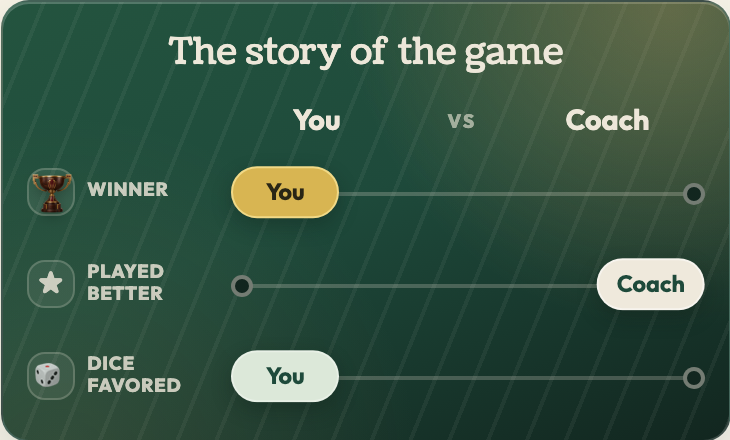
For the dice, the question is how much the roll helped in the position where it arrived, compared with what the engine expected before the roll. A six that escapes a prime can matter far more than a six that moves an already safe checker. Alongside that estimate, we review the moves the players chose and compare them with the alternatives available.
These are engine estimates about a recorded game. They help separate the contribution of the dice from what happened in the decisions, without producing a percentage of backgammon that is permanently “luck”. If someone says the game is 60% skill and 40% luck, we still need to know what they measured: one game or an evening, a match or money play, beginners or experts.
The dice mechanism stays the same, but the evidence supplied by the result changes. When two players make almost equally good decisions, their small difference in strength is difficult to detect through a few games. A larger gap can be visible much sooner.
The opponent belongs in the calculation
We can isolate this with a model that assumes a fixed winning chance per contest. It does not model checkers, the cube or how a match score changes play; it lets us examine the effect of repeating a noisy comparison.
The same series, two different skill gaps
Assume independent contests, no draws and one result per contest. The stronger player wins each contest with a fixed probability of either 55% or 75%. We calculate their chance of winning a majority of the series.
| Series | 55% per contest | 75% per contest |
|---|---|---|
| 1 contest | 55.00% | 75.00% |
| 11 contests | 63.31% | 96.57% |
| 51 contests | 76.41% | 99.99% |
Does this measure how much luck backgammon contains?
The 55% and 75% probabilities are assumptions, not measurements of players. These series do not represent 11-point or 51-point matches or the effect of the cube. The calculation shows how a skill gap and series length can change the reliability of a result.
The longer series is more reliable in both columns, but the size of the advantage matters enormously. Asking “how long before skill shows?” without specifying the gap between the players leaves a necessary part of the question unanswered.
A player whose chance is 50% remains at 50% of winning an odd-length series under these assumptions. More games cannot reveal a strength difference that the model says is absent. Nor does a stronger player become certain to win any finite series when each contest still has a chance of defeat.
One way researchers have tried to measure it
In a 2020 paper, Peter Duersch, Marco Lambrecht and Jörg Oechssler proposed measuring skill through how well player ratings predict results. They compared rating distributions with constructed benchmarks in which some chess results were replaced by random outcomes.
The paper’s method is useful because it makes the benchmark explicit. Its interpretation still depends on the population and format being observed. A dataset of closely matched tournament players asks a different question from one including complete beginners. We should not turn a result about those datasets into an intrinsic percentage stamped on the game.
Chess has no dice, but its results are still uncertain to us
Before a chess game, we can sensibly give each player a probability of winning. We do not know exactly how well each will play, which errors will occur or how their styles will interact. That prediction does not mean chess secretly contains a random move generator.
Backgammon includes an additional source of uncertainty within the rules. Even if the players’ decisions were specified completely, different legal dice sequences could produce different winners. Uncertainty about people and randomness in the game are separate things to keep track of when comparing results.
A format can reduce one kind of luck
Bridge offers a useful design example. In duplicate play, the same deals are played by different partnerships and their results compared. In a team match, the teams play both sides of the same deal at separate tables. Ginsberg’s account of computer bridge explains this comparison of performance on shared cards.
The method reduces the advantage of simply being dealt stronger hands. It does not remove the need to play those hands well, nor make every comparison free of variation. It changes which effects the competition is trying to hold constant.
Repeating the same idea at backgammon needs care: once different checker plays produce different positions, the same future roll may help one position and hurt another. Shared dice can be useful in a properly designed comparison, but equal sequences alone do not make two games equivalent.
Winning frequency is not the whole result
A backgammon player can win fewer games yet finish ahead because the wins were worth more points. Gammons and the cube matter, as does whether the objective is money-game equity or winning a match. A count of wins throws away some of the information needed to judge those choices.
Blackjack makes the distinction especially visible: the relevant expectation concerns money won and lost, including different stakes and payouts, rather than just the fraction of hands won. Our fixed-rule example shows a correct decision that still expects to lose.
What we want the review to help you do
In CUBE Backgammon, the point of showing the result alongside the estimated dice advantage is to give you a better starting point for reviewing the game. The analysis can draw attention to a fortunate roll, while the move review asks whether you made good use of it. It can also help you revisit a losing position without assuming that every setback came from a mistake.
The estimates depend on how the engine values positions, so they remain open to correction. They cannot establish exactly who would have won an alternative game with “fairer” dice: different rolls would have produced different positions and choices.
What we hope you take from the review is a clearer account of a game whose result may have been misleading, and a decision worth understanding before the next one. That gives us something useful to build into the app without pretending that every game contains the same measurable proportion of luck.
Sources: Duersch, Lambrecht and Oechssler, Measuring Skill and Chance in Games (2020), with an accessible paper copy; the NIST handbook’s binomial distribution; and Ginsberg, GIB (2001), for duplicate/team bridge context. The table is our own exact binomial calculation with assumed fixed probabilities, independent equal-weight contests and no draws.