When backgammon players counted doubles with matchsticks
Some players in the backgammon boom of the 1920s and 1930s tracked doubles with ordinary matchsticks. Period guides show why they needed to agree on what each match meant, while a 1930 advertisement offers a more compact solution.
CUBE BackgammonPublished Updated
In a newspaper lesson from 1930, J. Van Cleft Cooper introduces the subject with a reassuring sentence: “Scoring backgammon is very simple.” He then explains a method involving a bowl of ordinary matches and manages to muddle the count.
The column, reproduced in Albert Steg’s historical collection, starts with one match on the bar to represent a game worth one. At the first double another match is added, making two, but the instructions then jump to a third double putting four matches on the bar. Starting from one, successive doubles should produce two, four and eight.
It is a small error in a teaching column, and a useful introduction to a period when the stakes could be marked by little pieces of wood lying across the board.
A double you could simply announce
In the 1928 instructions of Grosvenor Nicholas, a player offers to double the stake before rolling. The opponent can accept and continue, or give up the current stake and start another game. That paragraph explains the agreement entirely in words.
The physical marker is a separate matter. Players need to remember how much the game is worth and who can offer the next double; a verbal agreement works only while everyone remembers the same state of affairs.
What does one match stand for?
Cooper’s column also describes another method, with one match placed on the bar for each double. In that system three matches mean that the initial stake has been doubled three times, making a game worth eight. He gets that calculation right later in the same column.
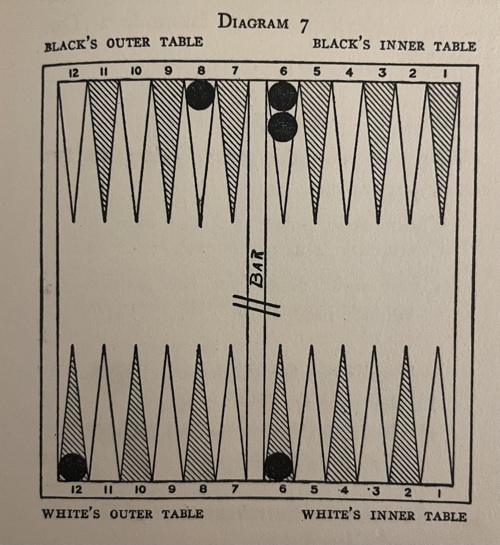
Elizabeth Clark Boyden’s The New Backgammon (1930) likewise describes counting the doubles with matches; a diagram in her book even shows them across the bar. If you counted matches as points instead, a stake of eight would need eight of them. Both arrangements can record the same game, provided the players agree which convention they are using.
Two matches across the bar in Elizabeth Clark Boyden’s The New Backgammon (1930), diagram 7, p. 39.Source: Albert Steg’s collection, New England Backgammon Club. Source · Public domain in the US.View the complete image ↗
Number of matches with an initial stake of 1, using either counting convention.
Times doubled
Stake
One per point
One per double
1
2
2
1
2
4
4
2
3
8
8
3
The distinction is easy to lose when giving instructions. A match can represent a unit of value, or an operation that doubles the value. Cooper’s column moves between the two systems, which makes its confident opening rather endearing.
A cube advertised for three dollars
Detail of Marshall Field & Company’s advertisement in the Chicago Tribune, 26 May 1930. The complete advertisement lists “Doubling Dice, Each $3”.Scan: Albert Steg’s collection, 20th-Century American Backgammon. Source · Public domain in the US.View the complete image ↗
By 26 May 1930, a Marshall Field & Company advertisement in the Chicago Tribune was offering doubling dice for $3 each, alongside complete backgammon sets and travelling sets. Its illustrations show both a pair of players and a group gathered around a board.
The advertisement gives us a firm example of a cube being sold at that date. Steg identifies it as the earliest depiction he has found, which is a narrower claim than proving when somebody first thought of making one. His research on early doublers also traces competing accounts of who introduced doubling itself.
A number you could put in front of a player
Ralph A. Bond’s 1930 instructions describe a cube numbered 2, 4, 8, 16, 32 and 64. Turning it displays the stake, while placing it in front of a player can identify who has the right to offer the next double.
That makes the object useful in two ways, and helps explain why its position matters as much as its upper face. Our article on the cube’s effect on a match explores the decisions that follow from that ownership.
The $3 accessory in the advertisement starts to look rather practical once you have tried keeping track of all those matches.